
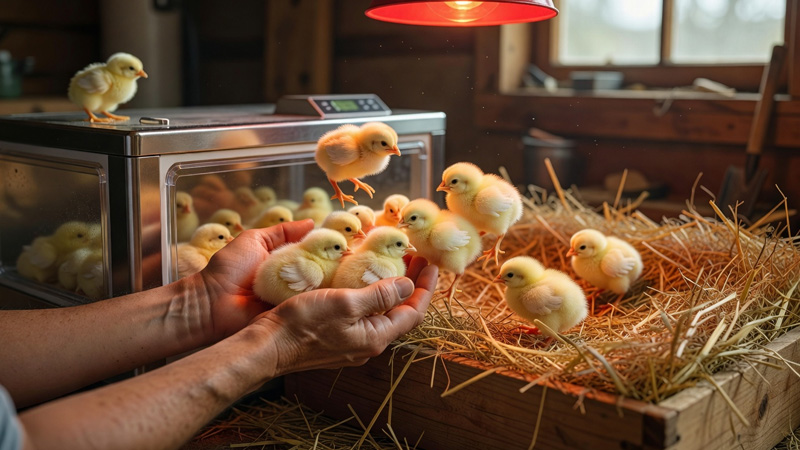
When eggs are placed inside an incubator, preparation for the chicks’ next stage should already be underway. While waiting for hatching to occur, proper care inside the incubator is essential. However, knowing the correct timing and method for transferring chicks to a brooder is even more critical.
The standard incubation period for chicken eggs is 21 days. This timeline allows you to anticipate when hatching will begin. To reduce risks during the transition, several key aspects must be clearly understood.
Table of Contents
Duration of the Hatching Process
On day 21, which is the expected hatching day, the incubator temperature should be maintained at approximately 100.5°F with a humidity level near 70%. For forced-air incubators, the temperature is typically set slightly lower at 99.5°F. If eggs were previously cooled, hatching may be delayed by a few days.
From the moment a chick begins pipping—creating a small hole in the shell—until it fully emerges, the process usually lasts between 5 and 6 hours. In some cases, it may extend up to 24 hours. When multiple eggs are incubated, the final chick may hatch within 36 hours after the first one.
Opening the Incubator During Hatching
As a general guideline, the incubator should remain closed during hatching. Although observing the process can be tempting, opening it causes a sudden drop in humidity. When this occurs, the membrane inside the egg may dry out, making it difficult for chicks to hatch successfully.
A dried membrane can adhere to the chick, preventing it from breaking free. This condition can develop quickly, which is why maintaining stable humidity is essential throughout the process.
Situations That May Require Opening the Incubator
In certain cases, opening the incubator cannot be avoided. This may include removing a chick that is causing disruption, addressing issues with a newly hatched chick, or fixing equipment such as a broken heat source.
If opening is necessary, exposure should be minimized. Adding warm water beforehand can help stabilize humidity, and the lid should be closed as quickly as possible.
Should You Assist a Chick During Hatching?
Intervening in the hatching process is generally discouraged. Assisted hatching carries significant risks and does not guarantee success. Lower humidity levels caused by opening the incubator may also negatively affect other eggs that are developing normally.
Failure to hatch can result from several factors, including insufficient humidity, weak chicks, or genetic issues. In some situations, chicks may simply be resting during the process, which can be mistaken for distress. Because of these variables, determining when to intervene is difficult and often unnecessary.
Feeding Newly Hatched Chicks
Newly hatched chicks rely on nutrients absorbed from the yolk sac, allowing them to survive without food and water for up to 48 hours. During this period, their primary needs are warmth, proper humidity, and rest. Providing feed or water immediately is not required.
When to Transfer Chicks to the Brooder
Chicks should remain inside the incubator until they are fully dry and fluffy. While some chicks hatch earlier than others, maintaining consistent temperature and humidity is still necessary for the remaining eggs.
As the first chicks dry, moisture from their bodies can cause slight fogging inside the incubator. Their activity and vocalization may also stimulate unhatched chicks to begin pipping.
There is no fixed duration for keeping chicks inside the incubator. Instead, their physical condition should guide the decision. Moving them too early, while still wet, can expose them to cold stress and increase mortality risk.
Ideal Brooder Conditions
Before transferring chicks, the brooder should already be prepared and stabilized for at least 24 hours. For layer chicks, a temperature of approximately 95°F with 40–60% humidity is recommended. For broilers, a slightly lower temperature of around 90°F is appropriate.
During the first week, temperature consistency must be maintained. Chick behavior can help indicate whether adjustments are needed. If chicks move away from the heat source and appear distressed, overheating may be the issue. If they cluster tightly near the heat, the environment is likely too cold.
Temperature should be reduced gradually by 5°F each week. By the sixth week, the brooder temperature can reach about 70°F, at which point chicks may be ready for transfer to a coop.
Conclusion
Temperature and humidity control are the most critical factors when moving chicks from an incubator to a brooder. Even minor fluctuations can affect their survival and development.
If adjustments are required, heat sources can be repositioned—lowered to increase warmth or raised to reduce it—while ensuring chicks cannot come into direct contact with them. Careful monitoring and gradual transitions will support healthy growth during this early stage.

