
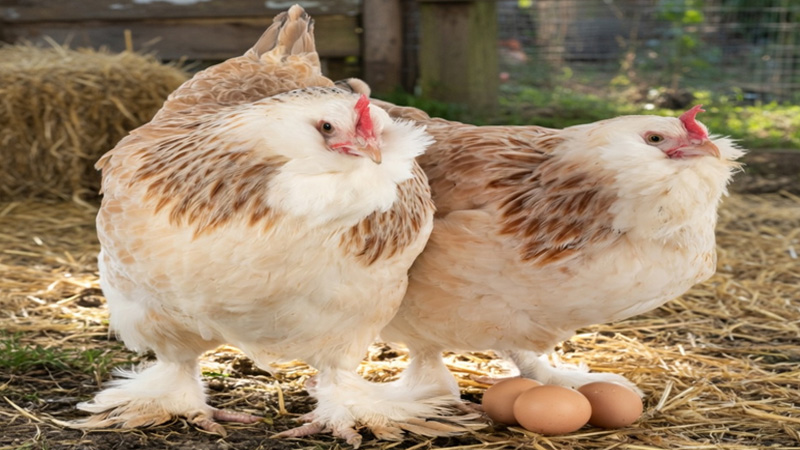
Some chickens are good egg layers. Some are pretty. Some are friendly. The Salmon Faverolle chicken somehow managed to become all three at the same time.
If you want a fluffy chicken that follows you around the yard, talks nonstop, handles cold weather well, and still gives a decent number of eggs every year, this breed is honestly hard to ignore.
And yeah, they look ridiculous in the best possible way.
Table of Contents
- What Is a Salmon Faverolle Chicken?
- Where Did Salmon Faverolle Chickens Come From?
- What Do Salmon Faverolle Chickens Look Like?
- How Big Do Salmon Faverolle Chickens Get?
- Temperament: Are Salmon Faverolles Friendly?
- Are Salmon Faverolles Good Egg Layers?
- Are Salmon Faverolles Good for Meat?
- Can Salmon Faverolles Handle Cold and Hot Weather?
- What Should You Feed Salmon Faverolle Chickens?
- Common Health Problems in Salmon Faverolles
- How to Care for Salmon Faverolle Chickens
- Pros of Raising Salmon Faverolle Chickens
- Cons of Raising Salmon Faverolle Chickens
- Final Thoughts
What Is a Salmon Faverolle Chicken?
Salmon Faverolle chickens are gentle dual-purpose birds from France that lay around 150–200 eggs yearly while also being known for their fluffy feathers, beards, and friendly personalities.
Most people first notice their appearance. Feathered legs, giant beard, soft salmon-colored feathers, and five toes instead of four. They almost look like somebody crossed a chicken with a couch pillow.
But once you spend time with them, the personality becomes the real reason people keep raising them.
Where Did Salmon Faverolle Chickens Come From?
The Salmon Faverolle breed started in France during the 1860s in a town called Faverolles, southwest of Paris.
The breed was developed by crossing several chickens together, including Brahma, Dorking, Houdan, Malines, French Rennes, and Flemish Cuckoo chickens. Nobody really knows the exact combination because official breeding records were never properly documented back then.
Originally, they were bred mainly for meat production. Farmers wanted a chicken that could tolerate confinement better than the aggressive Houdan breed.
Eventually, the Faverolle became popular in England around 1894 before reaching the United States shortly after.
Out of all the color varieties, the Salmon variety became the favorite almost immediately.
What Do Salmon Faverolle Chickens Look Like?
Salmon Faverolles are one of the easiest chicken breeds to recognize because of their fluffy beard, feathered legs, and unusual salmon-colored feathers.
The hens usually have creamy salmon feathers mixed with light brown shades across the back and wings. Roosters look completely different. They carry darker feathers around the chest, beard, and tail, often mixed with black, white, and deep brown.
Honestly, males and females look like two different breeds sometimes.
One strange detail people notice right away is the extra toe. Most chickens have four toes. Faverolles have five.
Their feathered feet and giant facial muffs also make them appear much larger than they really are.
How Big Do Salmon Faverolle Chickens Get?
Standard Salmon Faverolle roosters weigh around 8 pounds while hens average about 6 pounds.
There is also a bantam version for people who prefer smaller backyard chickens.
- Standard rooster: around 8 pounds
- Standard hen: around 6 pounds
- Bantam rooster: about 30 ounces
- Bantam hen: about 26 ounces
Even though they look huge because of all the feathers, their bodies are more compact than they first appear.
Temperament: Are Salmon Faverolles Friendly?
Salmon Faverolles are considered one of the friendliest chicken breeds you can raise.
This breed likes human attention way more than most chickens do. Some will literally walk beside you like tiny feathered assistants waiting for snacks or conversation.
They are curious birds. Very active too. Always investigating things they probably shouldn’t.
Most hens are talkative without being aggressive, while roosters can be noisy depending on personality.
What makes them different from many breeds is how affectionate they are. They tolerate handling extremely well and often enjoy sitting on laps.
That’s why families with children usually love them.
Do They Get Along With Other Chickens?
Yes, but Salmon Faverolles are submissive and can easily get bullied by aggressive breeds.
They usually stay low in the pecking order and avoid conflict. Because of that, mixing them with dominant chickens like aggressive Sussex lines or harsh game breeds can become stressful for them.
Gentle breeds like Cochins, Brahmas, and Buff Orpingtons are normally better companions.
Are Salmon Faverolles Good Egg Layers?
Salmon Faverolle hens lay around 150 to 200 light brown eggs per year and continue laying fairly well during winter.
That winter laying ability is one reason many backyard keepers still choose them today.
Most hens start laying around 20 weeks old, though some mature a little slower.
The eggs are usually medium-sized with light brown, cream, or pale pink coloring.
They are not industrial-level egg machines, but for a friendly ornamental breed, production is honestly pretty respectable.
Are Salmon Faverolles Good for Meat?
Yes. Salmon Faverolles were originally developed as meat birds before becoming popular as exhibition and backyard chickens.
They have broad bodies with decent muscle underneath all those feathers.
The problem today is availability. Finding quality breeding stock is harder than it used to be because the breed became rare for many years.
The Livestock Conservancy still lists them as a threatened breed.
Can Salmon Faverolles Handle Cold and Hot Weather?
Cold Weather
Salmon Faverolles are highly cold hardy and often continue laying eggs through winter.
Their thick feathers help them tolerate freezing temperatures surprisingly well.
Still, wet feathers combined with snow can cause frostbite problems, especially around feathered feet and combs.
Hot Weather
Heat is where Salmon Faverolles struggle more.
All those fluffy feathers trap heat quickly during summer.
You’ll probably see them panting heavily once temperatures rise. Good airflow, shade, and cold clean water become very important during hot months.
What Should You Feed Salmon Faverolle Chickens?
Salmon Faverolles eat standard chicken feed but tend to overeat if treats and scratch grains are given too often.
Starter feed for chicks, grower feed during adolescence, and quality layer feed for adults work perfectly fine.
They also love foraging.
Actually… sometimes too much.
This breed has a habit of eating random things it finds around the yard, which can occasionally lead to digestive issues.
Keeping treats under control matters because obesity can become a real problem with them.
Common Health Problems in Salmon Faverolles
The most common Salmon Faverolle health issues involve parasites, heat stress, and dirty feather buildup.
Their feathered legs and thick facial muffs create perfect hiding spots for mites and lice.
Regular inspection helps a lot because parasites can stay hidden for a while before obvious symptoms appear.
During summer, overheating is another concern. Their heavy feathering simply works against them in hot climates.
Most healthy Faverolles live around 5 to 7 years when properly cared for.
How to Care for Salmon Faverolle Chickens
Salmon Faverolles need extra feather maintenance, enough coop space, good ventilation, and protection from aggressive flock mates.
Their facial feathers sometimes grow so much that trimming becomes necessary to keep their vision clear.
Leg feathers also need attention during muddy or snowy seasons.
Wet feathered feet can become messy fast and increase frostbite risks.
Because they are naturally social, isolation usually stresses them out more than it would other breeds.
They do best in calm flocks where they are not constantly challenged.
Pros of Raising Salmon Faverolle Chickens
- Extremely friendly and easy to handle
- Excellent cold tolerance
- Unique fluffy appearance
- Good winter egg production
- Suitable for children and families
- Entertaining personality
- Good dual-purpose breed
- Usually peaceful with other gentle breeds
- Can adapt to confinement or free ranging
Cons of Raising Salmon Faverolle Chickens
- Not very heat tolerant
- Prone to mites and lice because of heavy feathers
- Can become overweight
- Often bullied by dominant chickens
- Noisy compared to quieter breeds
- Require feather maintenance and trimming
- Quality breeding stock can be difficult to find
Final Thoughts
Salmon Faverolle chickens are one of the best backyard breeds for people who want friendly, fluffy birds that also produce a steady supply of eggs.
They are weird-looking, noisy, curious, dramatic, and honestly kind of hilarious sometimes.
But that personality is exactly why people become attached to them so quickly.
If you can handle a little extra feather maintenance and protect them from aggressive flock mates, they reward you with companionship most chicken breeds simply don’t offer.
And considering how rare they still are, raising them also helps preserve a truly unique heritage breed.

