
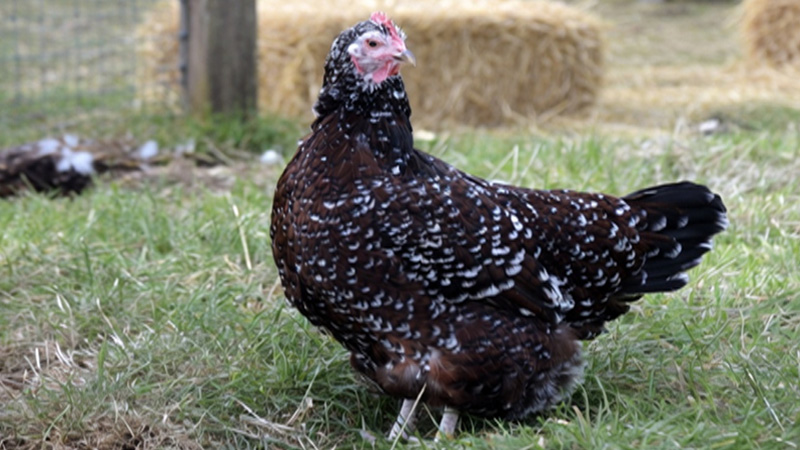
Some chicken breeds are productive. Others are friendly. The Speckled Sussex chicken somehow became famous for doing both while still looking like a bird made for exhibitions.
They lay a lot of eggs, grow decent meat, love human attention, and honestly make backyard flocks look better just by walking around.
And despite that elegant appearance, they are surprisingly low maintenance.
Table of Contents
- What Is a Speckled Sussex Chicken?
- Where Did Speckled Sussex Chickens Come From?
- What Do Speckled Sussex Chickens Look Like?
- How Big Do Speckled Sussex Chickens Get?
- Temperament: Are Speckled Sussex Chickens Friendly?
- Are Speckled Sussex Chickens Noisy?
- Are Speckled Sussex Chickens Good Egg Layers?
- Are Speckled Sussex Good for Meat Production?
- Can Speckled Sussex Chickens Handle Cold and Hot Weather?
- What Should You Feed Speckled Sussex Chickens?
- Common Health Problems in Speckled Sussex Chickens
- How to Care for Speckled Sussex Chickens
- Pros of Raising Speckled Sussex Chickens
- Cons of Raising Speckled Sussex Chickens
- Final Thoughts
What Is a Speckled Sussex Chicken?
Speckled Sussex chickens are calm dual-purpose birds known for laying around 250 eggs yearly while also producing quality meat and having a very friendly personality.
This breed is one of the oldest chickens from England and remains popular because it balances beauty, productivity, and easy management.
They are active without being aggressive. Curious without being destructive. Some even follow their owners around the yard like oversized pets.
Where Did Speckled Sussex Chickens Come From?
The Speckled Sussex originated in Sussex, England, and its history goes back incredibly far.
Writings from as early as 43 A.D. already mentioned the Sussex region as a producer of high-quality poultry during the Roman invasion of Britain.
The breed itself became officially recognized much later. It appeared at the first poultry show held at the London Zoo in 1845 where it was called the Old Sussex or Kent Fowl.
By 1902, breed standards were finally organized. Three original color varieties were selected:
- Speckled
- Red
- Light
The Speckled variety became the oldest and eventually one of the most admired.
Sussex chickens arrived in the United States around 1912, and the American Poultry Association later recognized the breed officially.
What Do Speckled Sussex Chickens Look Like?
Speckled Sussex chickens are famous for their mahogany feathers tipped with white speckles and dark bars that become more vibrant every year.
The color pattern changes as they age. That’s one thing people love about them.
Young birds start with lighter markings, but after each molt, more white speckles appear across the feathers. Older hens often look dramatically more colorful than younger ones.
Some feathers even show a shiny beetle-green effect under sunlight.
They have broad bodies, deep chests, short strong legs, and a confident posture that makes them stand out in a flock.
Their red combs, wattles, and earlobes are classic signs of brown egg layers.
And despite looking fancy, they are solid working birds underneath all that beauty.
How Big Do Speckled Sussex Chickens Get?
Standard Speckled Sussex roosters weigh around 7 to 8 pounds while hens usually weigh between 5 to 6 pounds.
There are bantam versions too, although they are harder to find.
- Standard rooster: 7–8 pounds
- Standard hen: 5–6 pounds
- Bantam rooster: about 3.3 pounds
- Bantam hen: about 2.4 pounds
They mature fairly quickly compared to some heritage breeds.
Temperament: Are Speckled Sussex Chickens Friendly?
Speckled Sussex chickens are considered one of the friendliest and easiest backyard breeds to handle.
They enjoy people. A lot.
Some owners joke that Sussex chickens have no concept of personal space because they constantly follow humans around looking for attention or snacks.
They are naturally curious birds and love observing whatever you are doing. Cleaning the coop? Expect one sitting nearby supervising your work like a tiny feathery manager.
They are calm enough for children and rarely show aggression.
Even roosters are often gentler than many other breeds.
Do They Get Along With Other Chickens?
Yes, Speckled Sussex chickens are sociable, though they can become victims of bullying from more aggressive breeds.
They usually avoid confrontation instead of fighting back.
Because of that, pairing them with calmer breeds works better than mixing them with highly dominant birds.
Are Speckled Sussex Chickens Noisy?
Speckled Sussex chickens are moderately noisy but usually not excessively loud.
The hens like to chatter throughout the day, especially after laying eggs or while foraging.
Roosters can crow often too, though they are generally less disruptive than some louder heritage breeds.
For most backyard keepers, the noise level stays manageable.
Are Speckled Sussex Chickens Good Egg Layers?
Speckled Sussex hens lay around 250 large light brown eggs per year and often continue laying during winter.
That’s one reason this breed stayed popular for generations.
Most hens begin laying around 20 weeks old, which is relatively early for a heritage dual-purpose breed.
Their consistency is impressive too. Many hens continue producing steadily long after some commercial hybrids slow down.
Are Speckled Sussex Good for Meat Production?
Yes. Speckled Sussex chickens were originally developed for meat and still produce tender flavorful meat today.
Their bodies are broad, muscular, and well-built for dual-purpose farming.
While modern commercial meat breeds grow faster, Sussex chickens still remain useful for small farms and homesteads wanting both eggs and meat from one flock.
Can Speckled Sussex Chickens Handle Cold and Hot Weather?
Cold Weather
Speckled Sussex chickens are very cold hardy and usually handle winter extremely well.
Their large body size and dense feathering help them stay comfortable during freezing temperatures.
Many hens continue laying even in colder months.
Hot Weather
Hot climates are more challenging for Speckled Sussex chickens because of their thick feathers.
Good ventilation, shade, and constant fresh water become important during summer.
Without proper cooling, they can become vulnerable to heat stress or heatstroke.
What Should You Feed Speckled Sussex Chickens?
Speckled Sussex chickens need balanced high-protein feed combined with controlled treats to prevent obesity.
These birds absolutely love eating.
Free ranging helps a lot because they are excellent natural foragers. They happily hunt insects, worms, seeds, and almost anything edible they discover outside.
Still, commercial grower and layer feed should remain their primary nutrition source.
Extra protein often helps maintain body condition, especially for dual-purpose lines.
Fresh vegetables, fruits, and greens also work well as healthy treats.
Too much scratch grain though? That’s where problems start.
Sussex chickens gain weight easily if overfed.
Common Health Problems in Speckled Sussex Chickens
Speckled Sussex chickens are generally healthy, but obesity, parasites, and heat stress are the most common concerns.
Because they are active foragers, they spend a lot of time scratching through dirt and grass where parasites can spread.
Routine coop cleaning and regular health checks help prevent issues.
Overeating is another problem people underestimate with this breed.
They are enthusiastic eaters and rarely know when to stop.
How to Care for Speckled Sussex Chickens
Speckled Sussex chickens need enough coop space, strong ventilation, balanced feeding, and protection from bullying.
Inside the coop, around 4 square feet per bird works well.
Outside runs should be larger whenever possible because they are active birds that enjoy movement and foraging.
Higher perches are recommended too since Sussex chickens actually fly better than many heavier breeds.
Comfortable nesting boxes help maintain strong egg production.
And honestly, clean water matters more than people think, especially during hotter months.
Pros of Raising Speckled Sussex Chickens
- Beautiful speckled feather pattern
- Excellent dual-purpose breed
- Friendly and easy to handle
- Good winter egg production
- Strong natural foragers
- Cold hardy
- Good with children and families
- Adaptable to confinement or free range
- Broody hens make excellent mothers
Cons of Raising Speckled Sussex Chickens
- Can become overweight easily
- Not highly heat tolerant
- May get bullied by aggressive breeds
- Require taller fencing because they fly well
- Bantam varieties are difficult to find
Final Thoughts
Speckled Sussex chickens remain one of the best all-around backyard breeds because they combine beauty, personality, egg production, and meat quality in a single bird.
Some breeds are productive but boring.
Others look amazing but are difficult to manage.
The Speckled Sussex somehow avoids both problems.
They are friendly enough for beginners, productive enough for homesteaders, and attractive enough to become the center of attention in almost any flock.
And once they start following you around the yard every morning, you’ll understand pretty quickly why so many chicken keepers refuse to give them up.

