
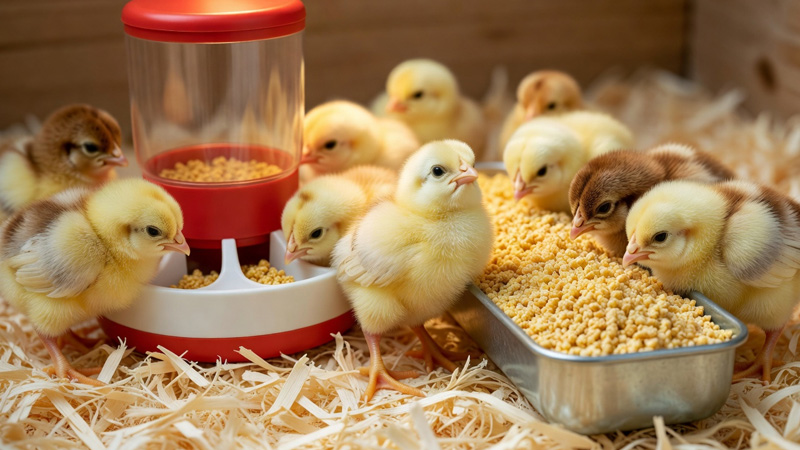
During the first 48 hours after hatching, baby chicks rely on nutrients absorbed from the yolk, so food and water are not immediately required. However, when chicks are transported from a hatchery, feeding should begin a few hours after arrival. At this stage, selecting a suitable feeder becomes important because chicks tend to scatter feed easily and are sensitive to moisture, which can lead to illness.
Chick feeders are available in multiple designs, sizes, and materials. Instead of choosing randomly, the feeder should match the brooder space and allow easy access for all chicks. Proper selection helps prevent overcrowding and reduces feed waste. Below are the main types of feeders used for baby chicks.
Table of Contents
Types of Chick Feeders
1. Long Trough Feeders
Long trough feeders are designed with multiple openings along an elongated structure, allowing several chicks to eat simultaneously. These feeders are typically placed on the floor and are made from either plastic or metal. Metal versions often include a wire guard that prevents chicks from stepping inside.
Plastic trough feeders provide a lower-cost alternative, although their lightweight design makes them easier to move or tip over. Some models include deeper containers that add weight and improve stability.
Advantages:
- Cost-effective
- Large feeding space
- Suitable for multiple chicks
- Simple cleaning process
- No assembly required
- Compatible with mash or wet feed
Disadvantages:
- Feed spillage is common
- Easily displaced or tipped
- Chicks may step inside and contaminate feed
- Higher feed waste
- Attracts rodents
2. Round Trough Feeders
Round trough feeders operate similarly to long trough models but use a circular design. They are suitable for smaller brooders but limit the number of chicks feeding at one time. Issues such as spillage and contamination remain similar to the elongated version.
3. Mason Jar Feeders
Mason jar feeders consist of an inverted container attached to a shallow base where feed collects. The base must be slightly wider than the container to allow access. Some models use metal feeding trays instead of simple bowls.
Advantages:
- Reduced contamination risk
- More stable and less likely to tip
- Space-efficient
- Less accessible to pests
Disadvantages:
- Limited capacity for small groups only
- Higher cost than trough feeders
- Requires regular monitoring of feed levels
4. Gravity Feeders
Gravity feeders dispense feed automatically as chicks consume it. Feed flows downward through openings due to gravity, ensuring a constant supply. Vertical tube designs are available for tight spaces and may require mounting.
Transparent containers are often preferred because they allow quick visual checks of remaining feed.
Advantages:
- Efficient use of space
- Minimal spillage
- Reduced feed waste
- Better protection from pests
- Easy maintenance
Disadvantages:
- Wet or mash feed may clog the system
- Less suitable for very young chicks
- Some designs require installation
5. Hanging Feeders
Hanging feeders are elevated versions of jar or gravity feeders. By suspending them at an appropriate height, contamination from droppings is minimized and rodents are less likely to reach the feed.
These feeders can be used for chicks of different sizes and remain effective even when adult chickens are present. However, heavier metal feeders are not ideal for hanging unless properly secured.
Key Tips for Selecting the Right Feeder
- Position feeders close to the heat source, especially in colder conditions.
- Choose designs with raised edges or lips to reduce feed waste.
- Avoid automatic feeders designed for adult chickens.
- Consider noise levels, as some feeders may startle chicks.
- Select trough feeders with covers to limit contamination.
- Prefer metal trough feeders for better stability.
- Ensure no sharp edges are present on metal feeders.
- Use transparent gravity feeders for easy monitoring.
- Adjust hanging feeders to the height of the smallest chick’s back.
- Select larger-capacity feeders to reduce frequent refilling and allow future expansion.
Conclusion
The effectiveness of a chick feeder is determined by functionality rather than appearance or cost. A well-chosen feeder ensures that chicks can eat safely and comfortably while minimizing feed waste. Spilled or contaminated feed not only increases expenses but also raises the risk of disease, particularly when moisture is involved. Proper feeder selection supports healthier growth and more efficient flock management.

